As the smart textiles market continues to grow across healthcare, personal protection, sportswear, and automotive applications, developers are seeking new ways to integrate electronic functionality directly into textiles, without the rigidity and complexity of conventional wiring.
To address this challenge, FILK Freiberg Institute, an independent research institution with expertise in polymer coatings for textile applications, collaborated with Optotransmitter-Umweltschutz-Technologie (OUT) e.V. The joint project, funded under the German Industrielle Gemeinschaftsforschung (IGF) program of the Bundesministerium für Wirtschaft und Energie (BMWE), focused on developing flexible, conductive polymer surfaces for next-generation smart textiles.
The goal was to enable the free distribution of multiple LEDs and sensors across a textile surface by creating a uniform conductive “potential field” within the material. This technology enables greater flexibility compared to conventional conductor tracks.
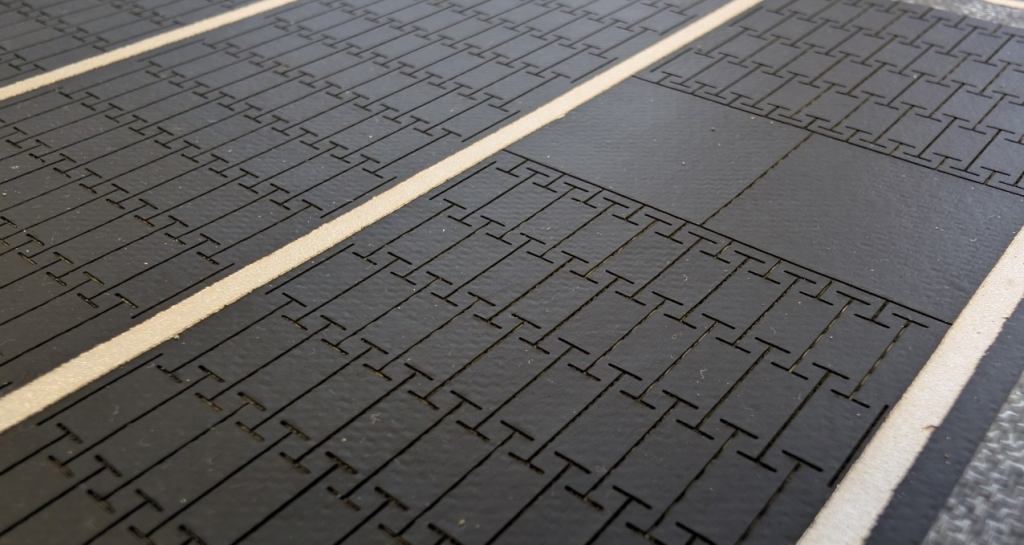
Creating a flexible conductive PU film using Impranil
To achieve the required combination of conductivity, elongation, and flexibility, FILK and OUT e.V. used water-based Impranil polyurethane dispersions from Covestro, creating a flexible conductive PU film into which carbon nanotubes were incorporated as electrically conductive additives.
Laser structuring of the conductive polymer surface allowed precise tuning of the electrical properties of the potential field, enabling LEDs and sensors to be distributed freely across the textile surface without traditional wiring. The active control of embedded LEDs through the integrated sensors supports real-time monitoring and bidirectional communication via modulated voltage or Bluetooth, depending on the application.
Dr. Martin Heise, Deputy Head of Department Functional Layer Systems at FILK Freiberg Institute, said: “Our goal was to rethink how electronics are integrated into textiles. By creating a conductive surface instead of fixed wiring using Impranil® polyurethane dispersions from Covestro, we can distribute sensors and light sources far more freely, enabling new smart textile designs and applications.”
Dr. Iris Vela-Wallenschus, Project Manager at OUT e.V. noted: “Distributed electronics, real-time sensing, and bidirectional communication within a flexible textile substrate represent a meaningful step forward for wearable technology. Working with FILK and Covestro, we’ve shown that this kind of adaptive functionality is achievable at a level of sophistication that is difficult to achieve with conventional wiring approaches.”
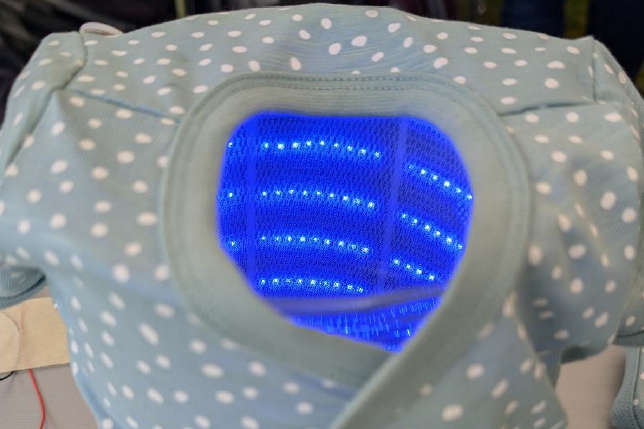
Enabling a new generation of smart textiles
The result is a technology platform that combines conductive polymer materials, sensor integration, and intelligent control. This platform unlocks possibilities for new applications such as sensor-controlled newborn bodysuits for jaundice phototherapy. Current standard treatments for neonatal jaundice rely on blue light at approximately 455 nm in hospital incubators. A flexible bodysuit integrating blue LEDs and sensors directly into the garment could continuously monitor therapy progress and adjust light intensity and distribution in real time. This approach may contribute to the development of more flexible treatment options with the support of midwives.
Beyond this application, Impranil® PUD-based formulations can be used in applications including heated textiles, pressure sensors, and flexible conductor tracks for wearable electronics. This system can also be adapted for scalable manufacturing processes such as digital printing, supporting broader adoption in industries including sportswear, automotive interiors, protective equipment, and connected IoT devices.
Dr. Torsten Pohl, Global Head of Textile Coatings at Covestro added: “This project highlights how material innovation can unlock new functionality in textiles. Our Impranil® water-based polyurethane dispersions provided the flexibility, durability, and processability needed to turn a complex concept into a scalable smart textile platform. We’re proud to have supported FILK and OUT e.V. in developing a system with real-world impact, from neonatal care through to the broader wearables market.”