CANNON’s revolutionary NEXUS composite mold heating system saves up to 70% energy compared to standard heating practices, and drastically reduces heat ramp-up time by 80%
At JEC World 2026, CANNON introduces the all-new NEXUS system, comprised of a composite mold, thermoregulation system and the associated controls. This revolutionary method for regulating mold temperatures allows for a 25% increase in efficiency compared to standard mold heating practices. In addition, the system opens up new optimization scenarios previously unavailable while reducing cycle times, with the aim of increasing part quality and potentially cutting raw material usage. Initially aimed at manufacturers using PU RIM (Reaction Injection Molding), the NEXUS system is also applicable to many processes that involve thermoset materials.
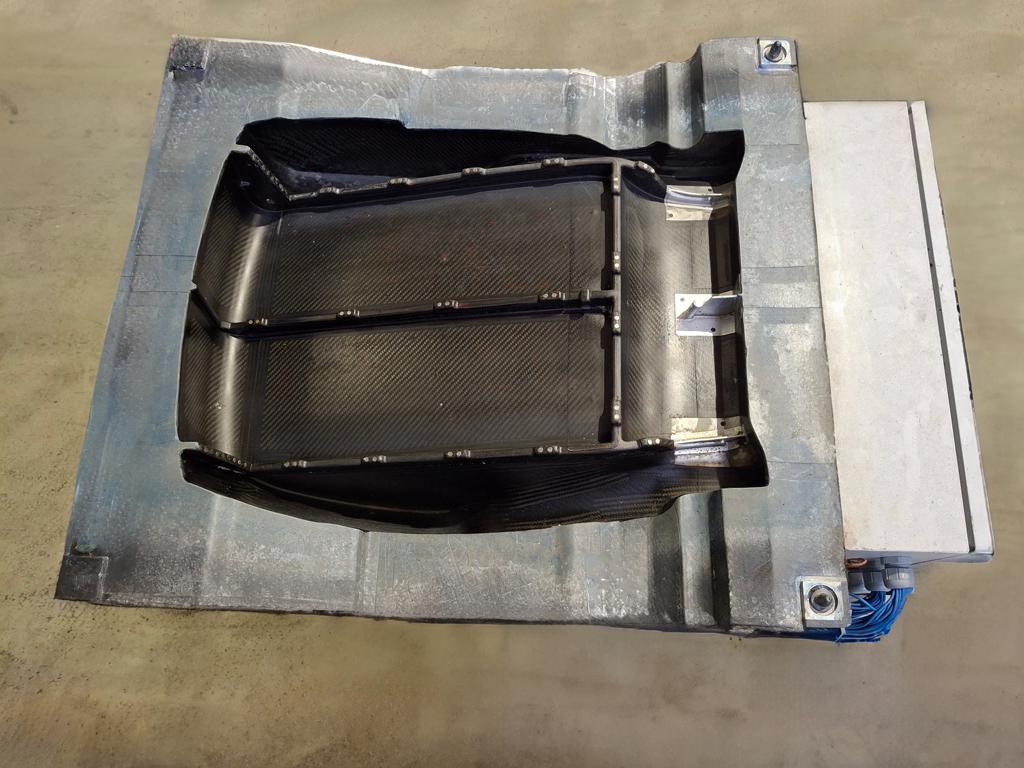
NEXUS technology uses the physical properties of composites not only as structural reinforcement, but as heating elements integrated into the mold itself. This allows for extremely fast temperature ramp-ups, up to 30°C per minute, as well as much more precise localized temperature control compared to fluid-based systems. Within the mold, this makes it possible to create differentiated thermal areas, separated by gradients less than a few millimeters. This feature is particularly useful in processes where the material’s chemical kinetics have to be carefully modulated. The nature of composites also offers the possibility of designing the mold with “tailor-made” properties, calibrating the heating rate, transverse conductivity or heat distribution according to the requirements of the part to be produced.
“In thermoset molding, heat management is a crucial factor in achieving consistent quality, competitive cycle times and energy-sustainable processes,” said Andrea Castelnovo, Technology and R&D Manager at CANNON Tipos. “Traditional technologies, based on metal tools and thermal fluids, have reached a physiological limit. Even when optimized, they rarely exceed 75% energy efficiency and impose thermal inertia that affects the entire production process. These considerations led to the creation of NEXUS, offering a completely new approach to mold temperature control, based on the intrinsic properties of the composite materials. The goal was simple in theory but revolutionary in practice: to heat only what is needed, in the shortest possible time, thus minimizing energy waste and dispersion.”
Developing the NEXUS system required over ten years of experimentation, beginning in 2015 with the aim of improving efficiency for RIM and HP-RTM processes. As literature on using composites as heating elements was limited, CANNON conducted a series of internal electrical and thermal tests to fully understand their behavior. Based on the data collected, a mathematical model was built to simulate an operational composite mold with integrated heating.
Even before the first NEXUS prototype was built, composite plates had been produced using the same principle. These allowed CANNON to compare simulation and reality, optimize the heater layout, and define the correct material sequence. The next step was to build a demonstration mold designed to replicate the operating conditions of a RIM process for polyurethane foams. Field tests then confirmed the theoretical results: the quality of the parts produced was equivalent to that obtained by more established technologies, while energy consumption was reduced by over 70%. Furthermore, the time needed to bring the mold temperature up was drastically reduced, from about one hour to around 8 minutes.
NEXUS is aligned with Sustainable Development Goal 12 for Responsible Consumption and Production, giving manufacturers the ability to precisely regulate temperatures in order to maximize material expansion and reaction performance. It reduces raw material usage and cycle times, while eliminating hazardous thermal fluids from the process; this, in turn, simplifies the plant’s overall energy infrastructure by removing the need for complicated heating and piping.