At JEC World 2026 (Paris Nord Villepinte, March 10 to 12), CANNON will present its revolutionary approach to recycling polyurethane (PU) and PU-glass fiber composites (GFRPs). The process has been developed in close cooperation with PU processor MAP S.p.A. and the University of Bergamo, with co-funding from the Italian strategic plan for the EU recovery fund NextGenerationEU. Named POSSIBLE, for “PrOduce SuStainabLE Industrial Bodies,” the project has laid the groundwork for PU and GFRPs end-of-life recycling and reuse, successfully demonstrating that ground foam and granulated parts can be used as secondary reinforcement materials in new composite formulations.
Thermosets account for about 12% of global plastic production, with over 40 million tons per year. Of these, polyurethane foams alone account for about 17 million tons, over 42%. While valued for their mechanical and thermal resistance, stability, and the possibility of incorporating reinforcing fibers, the combination of chemical cross-linking in the material and fibers makes traditional recycling almost impossible. Scientific research has developed several potential chemical recycling routes, but these work on a laboratory scale and are often too slow, too expensive, or incompatible with existing PU manufacturing processes. CANNON therefore decided to focus on a more direct approach, reintegrating pure or composite rigid PU waste through two complementary methods, both compatible with their high-pressure systems.
“In the plastics industry, sustainability and end-of-life discussions have taken center-stage, especially when it comes to reinforced thermosets,” said Maurizio Corti, Corporate R&D Director at CANNON. “However, rigid polyurethane foams and glass fiber reinforced polyurethane (GFRP) composites are indispensable materials for the energy efficiency goals of automobiles, buildings, or technical equipment, even though they remain among the most difficult to recycle. This is due to their cross-linked structure, which ensures stability and durability, but makes remelting and remodeling impossible. At present, landfilling and incineration are the most common end-of-life solutions, but these methods are becoming less acceptable, both from a regulatory and an environmental point of view.”
“It is in this context that the POSSIBLE project emerged,” said Dario Pigliafreddo, Mobility and Specialties Sales Manager at CANNON. “It provides the framework for targeted experimentation on rigid polyurethane foams and PU/GFRP composites recycling. The underlying idea was not to disrupt the system’s chemistry, introduce complex process steps, or require completely new lines, but to apply to a well-known and well-performing application of glass fiber impregnation flexibility and modularity to add both recycled granulate and powder, adapting a high-pressure foaming platform that some PU manufacturers already use.”
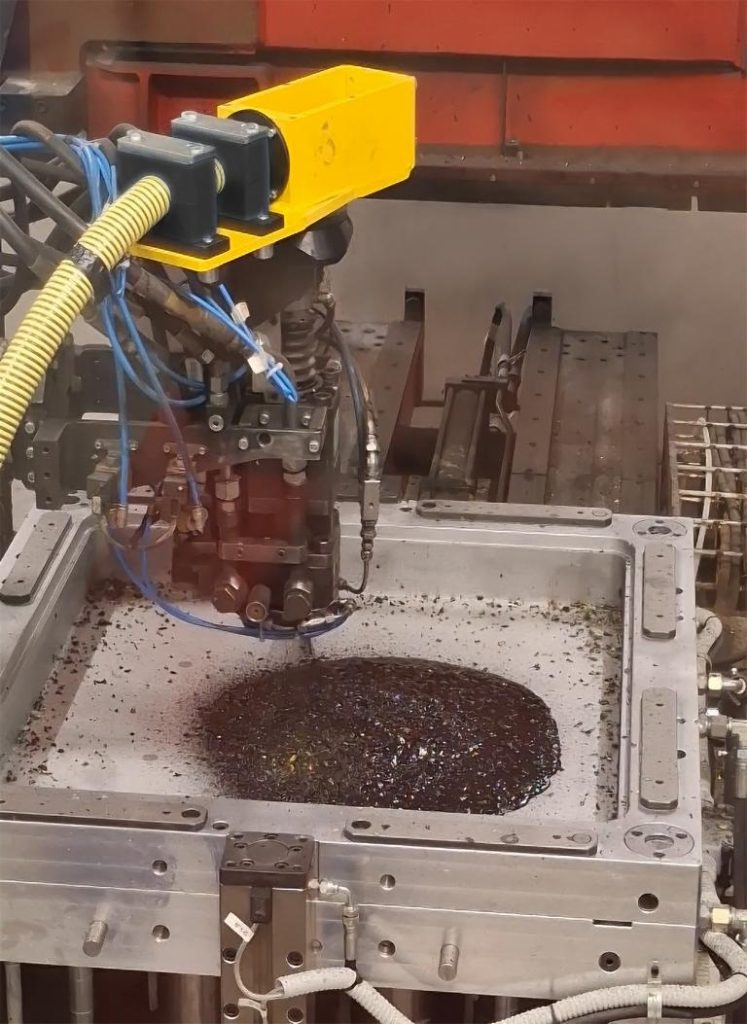
During the project, two complementary approaches were explored. The first involved transforming rigid foam waste into micrometric powders, which were then dispersed into the polyol to form a slurry and dosed as a liquid component using a mixing head. The second involved using rigid PU granulate and polyurethane-glass fiber composite, introduced as a solid filler into the mixture using dedicated dosing systems combined with the FPL 36 IW mixing head for Interwet-LFI (Long Fiber Injection) technology patented by CANNON.
For the first route, rigid foam waste is transformed into two types of powder, a fine powder (PU-A), with most particles below 75 µm, and a coarser powder (PU-B), between 300 and 500 µm. The dispersions were made by introducing the dried powders into a reactor with polyol, up to 20% by weight of the polyol stream, equal to about 5% of the foam. To handle these dense slurries, CANNON divided the isocyanate and the polyol into two streams, one “clean” and one “loaded.” This way, the mixing energy remains high, and the system remains stable, even with viscosities that can exceed 10,000 mPa·s. Then, the slurry is dosed via a scraper cylinder. Subsequent analyses show homogeneous panels with good distribution for the recycled powder. Furthermore, the thermal conductivity increases by only about 4% compared to the reference, which allows for maintaining valid insulating performance even with 3% recycled content in the foam.
For the second route, PU waste, including polyurethane-glass fiber composites, is transformed into granules. These are then dosed as a solid filler directly into the Interwet-LFI head. This technology is already in use to combine polyurethane and shredded glass fiber and allows recycled granules to be integrated into the mixing flow. To determine the most efficient feeding system, both pneumatic fluid bed transport and a flexible screw conveyor were tested. The former offers good results with dense, regular granules, but becomes unstable with light or powdery materials. The flexible screw conveyor proved to be more versatile: it allows flow rates from a few grams to over 100 g/s, without pulsations or bridging, making it ideal for GFRP granules from waste. With this configuration, panels containing up to 40% recycled granules by weight were produced, with uniform distribution throughout the thickness.
Subsequent testing by CANNON showed that recycling rigid polyurethanes and GFRP composites can become an integral part of production lines. They do not require invasive processes or radical changes to formulations but transform waste into a material that can be reused in the process, with immediate economic and environmental benefits. This is a concrete step towards circularity in thermosets, a family of materials for which recycling was previously considered almost impossible.
Based on research conducted during POSSIBLE, CANNON is now working on commercially viable solutions for recycling PU and GFRPs that will enter the market in the near future.
At JEC World 2026, CANNON can be found at Booth 5M72.